The Habit Every Great Storyteller Shares

Say someone in an interview asks you, “How in your career have you approached creative problem solving?”
I’d pull a story from my time at the NBA.
“Back in 2015, our marketing team kept pitching the same sponsorship ideas while revenue had flatlined. It didn’t make sense to me that we kept bringing the same people from our team together to brainstorm the same event activations and digital marketing campaigns.
So I thought, ‘What if we brought new perspectives to our brainstorms from our global offices?’
I sourced a new technology called Stormboard, and we got 20 of our colleagues from NBA China, Africa, and Australia to contribute.
It was such a success that we closed a new telecom brand for NBA All-Star Weekend, and our VP rolled out the technology across the whole department. Our close rate on sponsorship deals went up 23% year over year.”
That answer sounds like I came up with it on the spot.
I didn’t.
I pulled it from one row of a spreadsheet where I document my stories. I call it the Storytelling Rolodex.
If you came here from my video, the template is right below. So are 4 of my own stories, so you have real examples to model yours on.
Copy the free Storytelling Rolodex template
That link makes your own copy in Google Sheets. You’ll need to be signed in to a Google account.
(If the copy page doesn’t open, view the template here and click File, then Make a copy.)
Great storytellers are serial documenters
The most eloquent people I know are what I call serial documenters.
They keep track of the highlights and the lowlights from their lives, whether as mental notes or in writing.
So when someone asks them a tough question, they pick from a list of stories they already have.
Without that list, you’ll grab the first story you remember. It’s usually the wrong one, and the other person watches you search for the point while you’re still talking.
Only write down stories that pass 3 tests
You only write down a story when it meets 3 criteria.
First, it’s simple to understand. If someone needs 2 minutes of background before your story makes sense, you’ll lose them before the good part.
Second, it’s concrete, so the listener feels it. “Revenue had flatlined” and “20 colleagues from China, Africa, and Australia” give people something to picture. “I helped improve team collaboration” gives them nothing.
Third, it’s valuable to your audience. A great story about your vacation still falls flat in a quarterly review.
What counts as valuable depends on where you’re speaking.
In an interview, the story proves a trait the role needs. In a meeting, it helps the group make the decision in front of them. On stage, it gives the audience a lesson they’ll use after they leave.
How the Rolodex works
The template has 2 tabs. (The sheet itself is titled “Your Story Rolodex.”)
The Problems tab: 5 minutes a week
Once a week, take 5 minutes to write down any noteworthy challenge you ran into.
These problems don’t need an ending yet. The template says they “may or may not be resolved,” and I mean it.
You’re catching the problem while it’s fresh. The resolution comes later, and that’s when it becomes a story.
A few of the examples in the template:
- “I haven’t figured out how our teams can have more engaging sales calls. They’re currently too dull.”
- “I’ve stagnated my social media growth.”
- “The pool that I have to clean in our backyard is the bane of my existence!”
That last one won’t make it into a board meeting anytime soon (unless I find a great way to fix it). It still goes on the list.
The Stories tab: 10 to 15 minutes a month
Once a month, take 10 to 15 minutes to write down every possible story in your life. Start with the problems you’ve solved since last month.
Each row is one story, with 4 columns:
- The story one-liner. A short name you’ll recognize at a glance, like “Globalized our marketing brainstorms at the NBA.”
- The problem and stakes. What went wrong, and what it was costing you or the business.
- How you solved it. What you did, with the number if there is one.
- Why it matters to your audience. The takeaway, in a sentence or two.
Fill in the last column even when it feels obvious. It’s the line you’ll say out loud to connect the story back to the question.
Notice the problem and solution columns say “I (or someone I know well).” Your stories don’t all have to be yours. One of my favorites is my uncle’s.
Copy the template and fill in your first row
4 example stories from my Rolodex
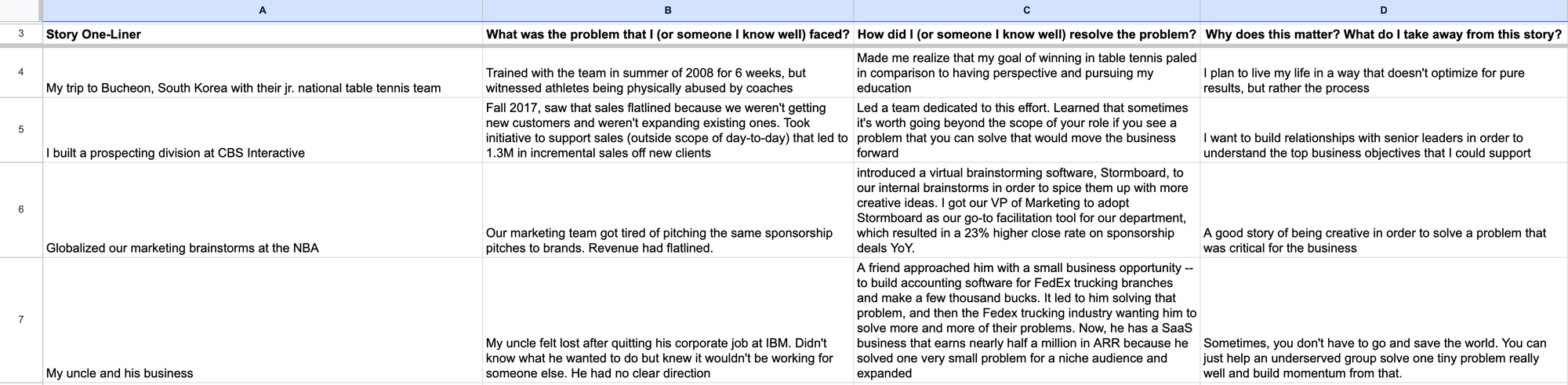
The Stories tab, with my 4 example rows. Every row in your copy follows the same 4 columns.
My trip to Bucheon, South Korea, with their junior national table tennis team
In the summer of 2008, I trained with the team for 6 weeks. During that time, I watched coaches physically abuse the athletes.
It made me realize my goal of winning in table tennis paled in comparison to having perspective and pursuing my education.
What I take away from it: I want to live my life in a way that cares about the process more than pure results.
This one’s a lowlight. Those belong in your Rolodex too, because they’re often the stories that show people how you think.
I built a prospecting division at CBS Interactive
In the fall of 2017, sales had flatlined. We weren’t getting new customers, and we weren’t expanding the ones we had.
I took the initiative to support sales, even though it was outside the scope of my day-to-day, and led a team dedicated to the effort. It led to $1.3M in incremental sales from new clients.
What I take away from it: build relationships with senior leaders so you understand the top business goals you’re able to support.
Globalized our marketing brainstorms at the NBA
You already heard this one at the top.
Our marketing team was tired of pitching brands the same sponsorship ideas, and revenue had flatlined. I brought in Stormboard to open up our brainstorms, and our VP of Marketing adopted it as the go-to tool for the department. Our close rate on sponsorship deals went up 23% year over year.
What I take away from it: it’s a good example of getting creative to solve a problem the business cared about.
My uncle and his business
My uncle felt lost after quitting his corporate job at IBM. He knew he didn’t want to work for someone else, but he had no clear direction.
Then a friend brought him a small opportunity: build accounting software for FedEx trucking branches and make a few thousand bucks.
He solved that problem. Then the FedEx trucking industry kept asking him to solve more of their problems. Today he runs a software business that earns nearly half a million dollars a year in recurring revenue.
What I take away from it: you don’t have to go save the world. Help an underserved group solve one tiny problem well, and build momentum from there.
Pick the story by the question
Once your Rolodex has a few rows, the hard part changes. You’ll have more stories than you need.
Pick the story by the question you’re answering. Don’t tell the one you remember first.
This is how I’d match my 4 rows to questions:
- “How have you approached creative problem solving?” The NBA brainstorms.
- “Tell me about a time you went beyond your role.” The CBS prospecting division.
- “What shaped how you think about success?” Bucheon.
- “Why should we start small?” My uncle.
If you’re preparing for an interview, scan your one-liners the night before and match a story to each question you expect.
If you’re preparing a presentation, you have more time. Pick one story from your Rolodex and use its takeaway column as the point of the whole talk.
Picking the story is half the job. You still have to tell it well. I use a 4-part structure called ATAT, and I break it down in Your Message Isn’t Clicking. Here’s Why.
If your stories ramble once you start telling them, Why Your Stories Fall Flat walks through the Past, Present, Future structure I teach my students.
Your first 5 minutes
Open the Problems tab in your copy and set a timer for 5 minutes.
Write down every challenge you ran into over the past month, big or small. Don’t overthink this portion.
Then pick the one with the clearest ending, move it to the Stories tab, and fill in all 4 columns.
One row is enough for today. Next month, you’ll add more.
If you found this helpful, you’ll love The Impromptu Speakers Academy. It’s my flagship program that’s helped hundreds of students master on-the-spot speaking in just 20 days to grow in their careers. It’s self-paced, so you can start today.
Preston
If you liked this, you'll enjoy these


Want me to train you or your team?
1:1 executive coaching
4 to 6 weeks of 1:1 coaching for your biggest moment: a keynote, a board meeting or an investor pitch. You'll walk in prepared and still sound like yourself.
See 1:1 executive coaching →Corporate trainings
Live communication training for teams that present, pitch and answer hard questions every week. Everyone practices on their own real work, out loud, with notes from me.
See corporate trainings →Get free weekly communication tips
Actionable speaking and writing advice every Tuesday.
You're in. First email lands shortly.